When Do You Need a DPIA for CCTV and Biometric Security Systems?
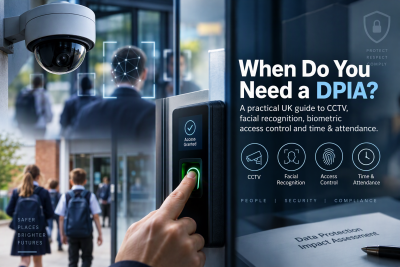
A practical UK guide to CCTV, facial recognition, biometric access control and time & attendance.
CCTV and access control technology has changed significantly. A security system may no longer simply record video or unlock a door. Modern systems can analyse behaviour, recognise faces, authenticate fingerprints, generate biometric templates and automatically make or support decisions about who should be admitted or flagged.
That creates an important question for organisations considering these technologies:
When do you need a Data Protection Impact Assessment (DPIA)?
The answer depends on what the system does, why it is being used, the people affected and the risks created by the processing.
For biometric recognition, the position is particularly important. Where biometric technology is used to uniquely identify an individual, special category biometric data is being processed. The Information Commissioner’s Office (ICO) states that organisations using a biometric recognition system must complete a DPIA before using it.
Conventional CCTV is different. Recording an identifiable person normally involves processing personal data, but a CCTV image does not automatically become special category biometric data simply because somebody’s face is visible.
However, this does not mean conventional CCTV should escape assessment. The scale and purpose of surveillance, the location of cameras, the people being monitored, new analytics and changes to an existing system can all materially change the privacy risk.
What is a Data Protection Impact Assessment?
A Data Protection Impact Assessment (DPIA) is a structured process used to identify and reduce data protection risks before carrying out processing that is likely to result in a high risk to people’s rights and freedoms.
For security systems, a meaningful DPIA should go much further than stating that CCTV or biometric technology is being installed.
It should help establish:
- what information will be captured;
- why that information is required;
- whether the processing is necessary and proportionate;
- whether a less intrusive solution could achieve the same objective;
- where information will be stored;
- who can access it;
- whether information leaves the premises;
- whether cloud services or third-party processors are involved;
- how long information will be retained;
- how access to recordings or biometric records will be audited;
- what happens when somebody leaves the organisation; and
- what risks the processing creates for the people affected.
The DPIA should therefore form part of the system design process, not become an administrative exercise after the equipment has already been purchased.
Does CCTV require a DPIA?
Not every conventional CCTV installation automatically requires a DPIA.
The requirement depends on whether the proposed processing is likely to result in a high risk to people’s rights and freedoms. Factors such as the nature, scope, context and purpose of the surveillance all matter.
For example, there is a significant difference between a camera monitoring a commercial site’s vehicle entrance and extensive surveillance within an environment occupied by children or people receiving care.
Important considerations can include:
- the number and position of cameras;
- whether public areas are monitored;
- whether monitoring is systematic;
- the reasonable expectations of people using the area;
- whether vulnerable people or children are affected;
- whether audio is recorded;
- whether remote monitoring is provided;
- whether artificial intelligence or video analytics are enabled;
- retention periods;
- how many people can access recordings; and
- whether footage is transferred to another organisation or cloud platform.
A useful approach is not simply to ask:
“Does this camera need a DPIA?”
Instead ask:
“What is this surveillance system doing, why are we doing it, who does it affect and what risks does that create?”
When should an existing CCTV DPIA be reviewed?
A DPIA should not necessarily be treated as a one-off document that remains unchanged throughout the life of a surveillance system.
Consider a school that originally installed conventional CCTV several years ago. Since the original assessment, it may have:
- added additional cameras;
- repositioned existing cameras;
- increased its recording retention period;
- introduced remote access;
- migrated storage into a cloud environment;
- enabled audio;
- introduced sophisticated video analytics; or
- added facial recognition.
The cameras might still appear to be the same CCTV system, but the processing and associated risk may have changed substantially.
A useful governance question is therefore: has your surveillance system changed since its original DPIA or privacy assessment was completed?
Is a CCTV image classed as biometric data?
Not automatically.
A conventional CCTV system may record a clear image of someone’s face. If that person is identifiable, the recording is personal data, but simply capturing the face does not necessarily mean it is being processed as special category biometric data.
The distinction becomes particularly important when technology performs specific technical processing on a person’s physical, physiological or behavioural characteristics for the purpose of uniquely identifying them.
This means there is an important distinction between:
Recording somebody’s face
and
Analysing somebody’s facial characteristics to identify them.
This distinction is increasingly important as conventional CCTV systems incorporate more advanced analytics and artificial intelligence.
When does CCTV become facial recognition?
Traditional CCTV might operate broadly like this:
Person → Camera → Recording → Human review
A facial recognition system can introduce additional processing:
Person → Camera → Facial analysis → Biometric template → Comparison → Potential match
Facial recognition technology can measure and analyse characteristics of a person’s face to create a biometric representation or template. That template can then be compared with other biometric information for purposes such as identification or verification.
This may be used for:
- facial authentication;
- identifying authorised individuals;
- live facial recognition;
- watchlist matching;
- retrospective searches of recorded footage; or
- alerting an operator to a potential match.
Adding facial recognition to CCTV therefore represents much more than simply adding another video analytic.
Does facial recognition CCTV require a DPIA?
Yes, where facial recognition is being used as biometric recognition to uniquely identify individuals, a DPIA should be completed before the processing begins.
The assessment needs to consider why facial recognition is required, whether its use is necessary and proportionate, and the potential impact on the rights and freedoms of the people whose information is processed.
A facial recognition DPIA may need to examine issues including:
- the purpose of the recognition;
- how biometric templates are generated;
- the source of reference images;
- who may be included on a watchlist;
- false-positive and false-negative matches;
- how potential matches are verified;
- whether automated decisions are made;
- accuracy and potential bias;
- retention of biometric information;
- security of biometric templates;
- access controls and audit trails; and
- what happens when a person’s data is no longer required.
If an alert is generated, another important design question is:
Does the technology make the decision, or does it provide information for an appropriately trained person to review?
Does biometric access control require a DPIA?
Fingerprint and facial recognition are increasingly used for access control on doors, gates and turnstiles.
The attraction is understandable. An access card can be lost, copied or given to another person. A PIN can be shared. Biometrics can provide much stronger assurance that the credential belongs to the person presenting it.
However, stronger identification also introduces additional data protection considerations.
If fingerprint or facial recognition technology is used to uniquely identify a person for access control, the organisation is processing special category biometric data.
A biometric access control project should therefore begin by establishing the requirement, rather than beginning with the choice of biometric reader.
Questions should include:
- What security problem are we trying to solve?
- Why is a conventional credential insufficient?
- Could card plus PIN or another multi-factor method achieve the objective?
- Is biometric identification required at every controlled door?
- Could it be restricted to particularly sensitive areas?
- Where will biometric templates be held?
- What alternative is available for somebody unable or unwilling to use the biometric system?
Does biometric time & attendance require a DPIA?
Biometrics can also be used to verify an employee’s identity when clocking in or out.
One common objective is preventing one employee using another person’s card, PIN or credential to register attendance on their behalf.
But an operational problem doesn’t automatically make biometric processing necessary and proportionate.
A useful DPIA question is:
“Does preventing credential sharing justify processing biometric information for the entire workforce, and could the objective reasonably be achieved another way?”
The assessment should also consider the employment relationship, lawful basis, the condition relied upon for processing special category biometric data, alternatives, transparency and how workers can exercise their data protection rights.
Employers should be particularly cautious about assuming that simply obtaining employee consent resolves all of these issues.
Can an employee refuse biometric access control or time & attendance?
This should be considered during system design rather than after somebody raises an objection.
There may also be people for whom a particular biometric method isn’t appropriate or reliable.
A practical system design should therefore consider:
- alternative credentials;
- failed biometric enrolment;
- temporary injuries;
- accessibility;
- reasonable alternatives;
- system failure; and
- the process for dealing with an objection.
A security system should not become operationally dependent on every individual being able to use a particular biometric characteristic.
What changes when CCTV monitors children?
Children require particular consideration when planning surveillance and biometric processing.
Children may be less aware of how their information is being collected, how it may subsequently be used and the rights available to them. This can increase the potential impact of surveillance and biometric technologies.
This is particularly relevant to:
- schools;
- nurseries;
- specialist education settings;
- SEND environments;
- residential education; and
- other safeguarding-sensitive locations.
Consider a school using conventional CCTV around entrances, corridors and external areas for safeguarding, security and incident investigation.
Now compare that with the same school introducing facial recognition capable of identifying pupils automatically or comparing people entering the site against a watchlist.
The equipment may look very similar, but the nature of the processing is fundamentally different.
The ICO has specifically considered biometric facial recognition involving school pupils and highlighted the need to assess necessity, proportionality, alternatives and the additional protections appropriate when processing children’s information.
In England and Wales, schools considering biometrics also need to be aware of specific requirements concerning the use of children’s biometric information in education, including provisions within the Protection of Freedoms Act 2012.
What about CCTV and vulnerable adults?
Similar care should be taken where surveillance affects adults who may have reduced ability to understand, challenge or exercise control over the processing of their information.
This may be particularly relevant within:
- care environments;
- supported living;
- healthcare settings;
- specialist accommodation; and
- other environments supporting vulnerable people.
It is important not to assume that every person receiving care lacks capacity or should automatically be treated in the same way. The circumstances, purpose and people affected need to be assessed individually.
Camera location is also critical.
A CCTV camera covering a site’s perimeter entrance presents very different considerations to continuous surveillance within an individual’s living, treatment or care environment.
Greater technical capability does not automatically create a justification for greater surveillance.
Why do necessity and proportionality matter?
A recurring principle throughout CCTV and biometric system design is whether the proposed processing is necessary and proportionate to the problem being addressed.
Before specifying the technology, establish the objective.
For example:
- Control entry into a general office: a card or mobile credential may be sufficient.
- Prevent credential sharing: card plus PIN or multi-factor authentication might address the risk.
- Require strong assurance of individual identity: biometric verification may potentially be justified.
- Prevent employees clocking colleagues in: biometric time & attendance might be considered, but alternatives should also be assessed.
- Record incidents for subsequent investigation: conventional CCTV may satisfy the requirement without facial recognition.
- Identify a known person within surveillance footage: facial recognition may potentially be considered, but introduces substantially greater privacy and governance requirements.
The fact that a security system is technically capable of performing a task doesn’t automatically make that processing necessary.
Where is biometric data actually stored?
This is one of the most important technical questions within a biometric DPIA.
A customer should be able to establish where biometric information travels throughout its complete lifecycle.
Depending on the system architecture, a biometric template might be held:
- on a credential;
- within a biometric reader;
- within an access control panel or controller;
- within an on-premises server;
- within a central database;
- within a manufacturer or service provider’s cloud infrastructure; or
- within backups of one or more of these systems.
The assessment should therefore go beyond asking whether the manufacturer’s reader is secure.
It should follow the information through the system:
Capture → Enrolment → Template creation → Transmission → Storage → Matching → Administration → Backup → Deletion
At each stage, organisations should understand who has access and what happens to the information.
Does a biometric reader store the actual fingerprint or face?
This is a common and important question.
Many biometric systems create a mathematical representation or biometric template based on characteristics extracted during enrolment rather than simply using a conventional photograph or fingerprint image for each authentication attempt.
However, describing something as a template does not remove the data protection implications.
If the information results from specific technical processing of an individual’s physical, physiological or behavioural characteristics and is used to uniquely identify them, it can constitute biometric data and, for identification purposes, special category data.
The actual architecture must therefore be established for the specific system rather than relying on statements such as:
“We don’t store fingerprints, so GDPR doesn’t apply.”
That is an unsafe assumption.
What should a CCTV or biometric DPIA consider?
There is no single question that determines whether a proposed surveillance or biometric system is appropriate.
A useful technical assessment should consider at least the following areas.
Purpose
- What problem is the system intended to solve?
- What is the specific security or operational objective?
- Why is the proposed processing required?
Necessity and proportionality
- Could the objective be achieved using less intrusive technology?
- Is surveillance limited to the areas where it is actually required?
- Could biometric identification be restricted to higher-risk areas?
People affected
- Are employees being monitored?
- Are members of the public affected?
- Are children involved?
- Are vulnerable people affected?
- Would people reasonably expect this processing?
Technology
- What information does the system actually capture?
- What analytics are enabled?
- Is biometric identification or verification taking place?
- Does the system create biometric templates?
- Are automated decisions involved?
Storage and transmission
- Where is information stored?
- Is it held locally or in the cloud?
- Does information leave the organisation?
- Which manufacturers, processors or service providers can access it?
- How is information secured in transit and at rest?
Access and accountability
- Who can view recordings?
- Who can access biometric records?
- Who can enrol or remove users?
- Are administrator actions recorded?
- Does the system maintain an access audit trail?
Retention and deletion
- How long is information retained?
- Why is that retention period necessary?
- What happens when an employee leaves?
- How are biometric records removed?
- Are copies present in backups?
Failure and alternatives
- What happens if recognition fails?
- How are false matches handled?
- Is human verification required?
- What alternative is available to somebody who cannot use the technology?
Who is responsible for completing the DPIA?
The organisation acting as data controller remains responsible for its data protection decisions and for ensuring an appropriate DPIA is completed where required.
A security installer should not simply make that decision on the controller’s behalf.
However, an effective DPIA for a technical security system requires accurate information about how that system actually works.
This is where the security systems specialist has an important role.
The organisation, its Data Protection Officer or data protection adviser may need technical information covering:
- system architecture;
- data flows;
- reader and camera operation;
- biometric template creation;
- local versus cloud storage;
- encryption;
- user permissions;
- audit logging;
- retention capabilities;
- backup arrangements; and
- secure deletion.
A DPIA is only meaningful if the people completing it understand what the technology actually does.
DPIA First. Technology Second.
At I Security, we don’t believe the first question when considering facial recognition or biometric security should be:
“Which reader or camera should we install?”
The starting questions should be:
“What are we trying to protect?”
“What problem are we trying to solve?”
“Is this level of surveillance or biometric identification necessary and proportionate?”
Once those requirements are understood, the technology can be designed around the organisation’s security, operational and data protection needs.
This is particularly important within schools, nurseries, care settings and other safeguarding-sensitive environments, where good security design must consider not only technical capability but the people affected by its use.
Planning or Reviewing a CCTV or Biometric System?
If you are considering CCTV, facial recognition, biometric access control or biometric time & attendance, understanding the way the proposed technology processes information should form part of the project from the outset.
I Security can help organisations assess the technical architecture of proposed or existing security systems, including how information is captured, processed, transmitted, stored, accessed, retained and deleted.
We can also help identify alternative security technologies where biometric processing may not be necessary and provide the technical system information your organisation, Data Protection Officer or data protection adviser needs when completing or reviewing a DPIA.
Planning a new system, adding biometric functionality or reviewing an existing CCTV installation? Speak to I Security before the technology is specified.
Frequently Asked Questions
Does every CCTV system need a DPIA?
No. A DPIA is required where processing is likely to result in a high risk to people’s rights and freedoms. The purpose, scale, location, technology and people being monitored should all be considered. Even where a formal DPIA is not mandatory, documenting why surveillance is necessary and proportionate represents good governance.
Is CCTV footage biometric data?
Not automatically. CCTV footage of an identifiable person is generally personal data. It becomes a biometric issue where specific technical processing of physical, physiological or behavioural characteristics is used for purposes such as uniquely identifying an individual.
Does facial recognition require a DPIA?
Where facial recognition is used as a biometric recognition system to uniquely identify individuals, a DPIA should be completed before the processing begins.
Does fingerprint access control require a DPIA?
Where fingerprints are technically processed to uniquely identify people for access control, this involves special category biometric data and a DPIA should be completed before using the biometric recognition system.
Does biometric time & attendance require a DPIA?
Where fingerprint, facial recognition or another biometric characteristic is used to uniquely identify employees for time and attendance purposes, the organisation should complete a DPIA and consider necessity, proportionality, lawful basis, the applicable special category condition and suitable alternatives.
Are photographs automatically biometric data?
No. A photograph does not automatically become special category biometric data simply because someone’s face is visible. The purpose and technical processing applied to the image are important. Using facial characteristics through biometric recognition to uniquely identify an individual changes the data protection position.
Do schools need to consider additional rules when using biometrics?
Yes. Children merit particular protection under data protection law. Schools in England and Wales must also consider specific statutory requirements concerning children’s biometric information, including relevant provisions of the Protection of Freedoms Act 2012.
Who should complete the DPIA for a security system?
The data controller is responsible for ensuring that an appropriate DPIA is completed where required. Security specialists can provide essential technical information about system architecture, data flows, storage, security, retention, biometric processing and access controls to support that assessment.
Further Guidance
Organisations considering CCTV or biometric technology should refer to current guidance from the Information Commissioner’s Office, including its guidance on Data Protection Impact Assessments, video surveillance, biometric recognition and facial recognition technology.
Data protection requirements and regulatory guidance can change. This article provides general information about security system design and data protection considerations and should not be treated as legal advice. Organisations should obtain appropriate data protection or legal advice for their particular circumstances where required.