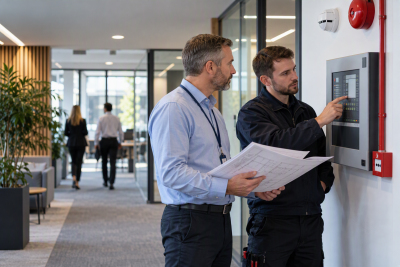
Businesses must have suitable fire detection and warning arrangements to protect people and support safe evacuation. In many commercial premises, this means installing an appropriate fire alarm system, but the exact requirement should be determined through a suitable and sufficient fire risk assessment.
The type of fire alarm system required will depend on factors such as the size and layout of the building, how it is used, the number and needs of its occupants, the fire risks present and the evacuation strategy adopted.
Quick Answer
In many commercial premises, yes. The law does not require every business to install the same type of electrical fire alarm system, but suitable arrangements must be in place to detect fire where necessary, warn people and support safe evacuation.
The appropriate arrangement should be identified through a suitable and sufficient fire risk assessment. A small, simple and continuously occupied premises may require different measures from a multi-storey office, warehouse, factory, hotel, care setting or building providing sleeping accommodation.
The important question is not simply, “Does the law say I must buy a fire alarm?” It is:
Can a fire be detected and can everyone at risk be warned with enough time to evacuate safely?
Key Points
- Not every business requires the same type of fire alarm system.
- The fire risk assessment should establish the warning, detection and evacuation objectives for the premises.
- BS 5839-1:2025 is the principal British Standard code of practice for fire detection and fire alarm systems in non-domestic premises.
- Routine servicing does not automatically confirm that the original system design remains suitable for the building’s current use.
- Alterations, changes of use and increased occupancy can affect fire alarm coverage and performance.
- An older fire alarm system may sometimes be extended or upgraded instead of being completely replaced.
- Responsibility for the fire-safety arrangements remains with the Responsible Person.
Understanding Your Legal Responsibilities
If you own, manage, occupy or control business premises, you may have legal responsibilities for fire safety.
In England and Wales, the principal legislation covering fire safety in most non-domestic premises is the Regulatory Reform (Fire Safety) Order 2005.
The legislation places duties on the Responsible Person to assess fire risks and put appropriate fire precautions in place to protect relevant persons.
Depending on how the premises are occupied and managed, the Responsible Person may be:
- The employer, where the premises are a workplace
- The owner or landlord
- The occupier
- A facilities manager, building manager or managing agent
- Another person with control over all or part of the premises
More than one Responsible Person may exist within shared or multi-occupied premises. Where responsibilities overlap, the relevant parties must cooperate and coordinate their fire-safety arrangements.
The Responsible Person must ensure that appropriate arrangements are made to:
- Assess the risk of fire
- Identify the people who may be at risk
- Put suitable fire precautions in place
- Provide safe means of escape
- Warn occupants when a fire occurs
- Plan for emergencies
- Provide appropriate information, instruction and training
- Maintain fire-safety measures in effective working order
- Record and regularly review the fire risk assessment
The law does not prescribe one identical fire alarm solution for every building. The precautions should be proportionate to the premises, the people using it and the risks identified.
Why the Fire Risk Assessment Comes First
A fire alarm system should not be selected solely because of price, convenience or what another organisation has installed.
The starting point should be the building’s fire risk assessment.
A suitable and sufficient fire risk assessment should identify:
- Potential fire hazards
- Sources of ignition
- Combustible and flammable materials
- People who may be at risk
- Existing fire precautions
- Available escape routes
- Deficiencies within the current arrangements
- Additional measures required to manage the risk
The assessment can help establish:
- Whether a fire alarm system is required
- Whether manual warning arrangements are sufficient
- Whether automatic fire detection is necessary
- Whether existing detection is adequate
- Whether specific higher-risk areas need additional protection
- The evacuation strategy that the warning system must support
- Whether other measures, such as emergency lighting and fire-safety signage, are required
We are frequently contacted after a fire risk assessment has already been completed and recommendations have been made.
One common misconception is that the fire risk assessment will provide a complete fire alarm design.
In practice, assessments will often identify that additional detection, warning or protection is required without specifying every detector, alarm device, cable, interface or cause-and-effect requirement.
Translating the fire risk assessment, fire strategy and evacuation requirements into a properly documented fire alarm design is normally a separate specialist activity.
What Does a Fire Risk Assessment Consider?
A competent assessment will normally consider matters such as:
- The size, layout and construction of the building
- The number and location of occupants
- People who may require assistance to evacuate
- Whether anyone sleeps on the premises
- Sources of ignition
- Combustible or hazardous materials
- Existing fire detection and alarm arrangements
- Escape routes and final exits
- Fire doors and compartmentation
- Emergency procedures
- Staff training and fire drills
- Maintenance and testing arrangements
- The time required for occupants to reach safety
The findings should then inform the level of fire detection, warning and other fire precautions needed within the premises.
When Should a Fire Risk Assessment Be Reviewed?
One of the biggest mistakes businesses make is treating the fire risk assessment as a one-off exercise.
It should be reviewed regularly and whenever there is reason to believe it is no longer valid or significant changes have taken place.
Relevant changes may include:
- Building alterations or extensions
- New internal walls or partitions
- A change in how an area is used
- Changes in occupancy
- New machinery or production processes
- Changes in storage arrangements
- The introduction of hazardous materials
- Changes to escape routes
- Changes to the evacuation strategy
- Alterations to the fire alarm system
- A fire or significant fire-safety incident
In our experience, a fire alarm system can become unsuitable not because the equipment has failed, but because the building has changed around it.
A system that was appropriate when installed may no longer provide the intended protection after internal alterations, expansion, increased occupancy or a change of use.
When Is a Fire Alarm System Likely to Be Needed?
The answer depends on the fire risk assessment, evacuation arrangements and risks within the premises.
A fire alarm system is more likely to be required where:
- Sleeping accommodation is provided
- Members of the public regularly visit the premises
- The building has several floors
- The premises has a large or complex layout
- Occupants cannot easily see or hear activity throughout the building
- A fire may not be discovered immediately
- High-risk processes or equipment are present
- Combustible or flammable materials are stored or used
- People may need additional time or assistance to evacuate
- The premises is occupied when only a small number of staff are present
- A developing fire could affect escape routes before being discovered
Even comparatively small offices, shops, workshops and warehouses may require an electrical fire alarm system where shouting “fire” or using another simple method would not reliably warn everyone at risk.
Not Sure Whether Your Existing Fire Alarm Is Still Suitable?
New partitions, additional occupants, changes of use and altered evacuation arrangements can all affect whether an existing fire alarm system remains appropriate.
I Security Ltd can review the existing equipment and available documentation before recommending whether the system should be retained, extended, upgraded or replaced.
We support commercial organisations across Bolton, Greater Manchester, Lancashire and the wider North West with fire alarm reviews, installation, upgrades and maintenance.
The objective is to identify a proportionate and maintainable solution rather than recommend unnecessary replacement.
What Is BS 5839-1:2025?
Commercial fire detection and fire alarm systems are commonly designed, installed, commissioned and maintained with reference to BS 5839-1:2025.
BS 5839-1:2025 is the current British Standard code of practice for fire detection and fire alarm systems in non-domestic premises.
The standard is not itself legislation. However, following its recommendations can help demonstrate that a fire alarm system has been competently designed, installed, commissioned, handed over and maintained.
The standard covers matters including:
- System design
- Fire alarm categories
- Manual call points
- Automatic fire detection
- Alarm devices
- Control and indicating equipment
- Power supplies
- Cabling
- Zoning
- Interfaces with other systems
- Commissioning
- Certification
- Handover
- Inspection and servicing
Fire Alarm Categories at a Glance
Fire alarm categories describe the principal objective and extent of protection provided by the system. They should not be selected simply by choosing the category that appears to provide the greatest amount of detection.
The appropriate category should reflect the fire risk assessment, fire strategy, evacuation arrangements and clearly defined protection objectives for the premises.
| Category | Primary Objective | General Extent of Protection |
|---|---|---|
| M | Manual Warning | Manual call points allow occupants to raise the alarm. Category M does not itself provide automatic fire detection. |
| L | Life Protection | Automatic fire detection is provided to the extent defined by Category L1, L2, L3, L4 or L5. |
| P | Property Protection | Automatic fire detection is provided to the extent defined by Category P1 or P2. |
A fire alarm system can have more than one objective. The category, scope and any variations should be clearly defined in the system specification and supporting documentation.
Understanding Commercial Fire Alarm Categories
BS 5839-1 uses system categories to describe the objective and extent of protection provided.
The required objective should be established from the fire risk assessment, fire strategy, building requirements, insurer requirements and any relevant authority or stakeholder conditions.
A competent fire alarm designer can then translate those requirements into an appropriate category and documented design.
Category M: Manual Fire Alarm Systems
A Category M system provides manual means for occupants to raise the alarm, normally through manual call points.
It does not, by itself, provide automatic detection and depends on somebody discovering the fire and operating a call point.
Manual protection may be suitable where a fire is likely to be discovered quickly and occupants can raise the alarm without delay. The suitability of this approach must be established for the particular premises.
Category L: Life Protection Systems
Category L systems incorporate automatic fire detection with the primary objective of protecting life.
Category L1
Automatic fire detection is installed throughout substantially all areas of the building.
Category L1 provides the highest level of automatic life-safety detection within the Category L structure.
Category L2
Automatic fire detection is provided in defined parts of the building in addition to the areas normally protected by a Category L3 system.
The additional detection is intended to address particular areas of higher fire risk or increased life risk.
Category L3
Automatic detection is generally provided on escape routes and in rooms or areas opening onto those routes.
The objective is to provide warning before escape routes become impassable.
Category L4
Automatic fire detection is generally provided within escape routes, such as circulation areas, corridors and stairways.
Category L5
A Category L5 system is designed to satisfy a specific life-safety objective that is not adequately addressed by Categories L1 to L4.
The purpose, extent and limitations of a Category L5 system should be clearly defined within the system specification.
Category P: Property Protection Systems
Category P systems are primarily intended to protect buildings, assets and business operations by supporting earlier detection of fire.
Category P1
Automatic fire detection is installed throughout substantially all areas of the building to provide property protection.
Category P2
Automatic detection is installed within defined parts of the premises where the fire risk, potential loss or business impact justifies protection.
A system may have more than one objective. For example, a specification may combine manual protection with defined life-safety or property-protection measures.
How to Determine What Fire Alarm System Your Business Needs
- Complete or review the fire risk assessment.
Identify the risks, people requiring protection and deficiencies within the existing arrangements. - Confirm how the building is used.
Consider occupancy, opening hours, sleeping risks, vulnerable occupants and changes of use. - Confirm the evacuation strategy.
Establish how occupants will be warned and how they are expected to reach safety. - Define the protection objectives.
Determine whether the system is intended to provide manual warning, life protection, property protection or a combination of objectives. - Develop a documented specification.
Record the required category, system coverage, interfaces, cause-and-effect operation and responsibility boundaries. - Design, install and commission the system.
Use competent providers and ensure each stage is appropriately documented and certified. - Provide suitable handover information.
This should include relevant certificates, drawings, zone information, user instructions and the fire alarm logbook. - Test, maintain and review the arrangement.
Reconsider the fire alarm requirements whenever the building, occupancy, activities or evacuation procedures change.
What Is Needed Before a Fire Alarm System Can Be Designed or Quoted?
A reliable quotation should be based on more than a brief walk around the premises and a count of visible devices.
Depending on the project, a competent provider may need:
- The current fire risk assessment
- The building’s fire strategy
- The required fire alarm category or protection objective
- Current building plans
- Details of occupancy and building use
- The evacuation strategy
- Existing fire alarm drawings
- Design, installation and commissioning certificates
- Cause-and-effect information
- Details of interfaces with doors, lifts, plant or smoke-control systems
- Alarm receiving centre or monitoring requirements
- Requirements imposed by an insurer, landlord or relevant authority
- Details of planned building changes
Where essential design information is unavailable, assumptions, responsibility boundaries and any agreed variations should be clearly recorded.
Why Fire Alarm Maintenance Does Not Automatically Confirm Compliance
One of the most valuable lessons for business owners is that a maintained system is not automatically proof that the overall fire alarm design remains appropriate for the premises.
When we attend sites with regular maintenance contracts, we often find equipment that remains operational and serviceable.
- Detectors respond when tested
- Manual call points operate
- Alarm devices function
- The control panel operates normally
- The standby batteries remain serviceable
However, routine servicing primarily assesses the condition and operation of the system within the agreed maintenance scope.
It should not automatically be treated as a complete redesign, a fresh fire risk assessment or confirmation that the original system category remains appropriate for the building’s current use.
Buildings evolve over time:
- Occupancy increases
- Rooms are subdivided
- Offices become storage areas
- Escape routes are altered
- Production processes change
- Extensions are added
- Evacuation procedures develop
The fire alarm system may remain exactly as it was when first installed.
This can result in a system that is well maintained but no longer suited to the layout, use or fire-safety strategy of the premises.
Where significant alterations, extensions, occupancy changes or system modifications have occurred, a separate review of the fire risk assessment, fire alarm design and supporting documentation may be required.
The Hidden Challenge: Missing Fire Alarm Documentation
One of the most common problems encountered with older fire alarm systems is missing or incomplete documentation.
Important records may include:
- Design specifications
- Design certificates
- Installation certificates
- Commissioning certificates
- Acceptance or handover records
- As-fitted drawings
- Zone plans
- Cause-and-effect documentation
- Agreed variations
- Maintenance records
- The fire alarm logbook
Without these records, it can be much more difficult to establish what the system was originally intended to achieve, which areas should be protected and how connected equipment should respond.
Documentation is not simply an administrative exercise. It supports effective testing, maintenance, fault diagnosis, future alterations and long-term system management.
Why the Fire Alarm Logbook Matters
The fire alarm logbook provides an ongoing record of the system’s operation, testing and maintenance.
It should be kept up to date and made available to the Responsible Person and servicing organisation.
Relevant entries may include:
- Routine fire alarm tests
- Fire drills
- Fire alarm activations
- False alarms and unwanted fire signals
- Faults and disablements
- Maintenance visits
- Corrective work
- System alterations
- Changes to the building
- Agreed variations
Accurate records can reveal recurring faults, false alarm patterns and changes that may require further investigation.
Does an Older Fire Alarm System Always Need Replacing?
No. The age of a fire alarm system does not automatically mean that every component must be removed and replaced.
Subject to a detailed technical assessment, it may be possible to retain compatible and serviceable devices, circuits or cabling while replacing the control and indicating equipment or upgrading selected parts of the system.
A partial upgrade may offer benefits such as:
- Reduced installation cost
- Less disruption
- Shorter installation programmes
- Improved reliability
- Modern control and diagnostic functions
- Continued use of suitable existing infrastructure
This approach is not appropriate in every case.
Before existing equipment is retained, consideration should be given to:
- Equipment compatibility
- Condition and remaining service life
- Availability of replacement parts
- The existing fire alarm category and design objectives
- Cable type, condition and integrity
- Circuit loading and configuration
- Device condition and manufacturer support
- Cause-and-effect requirements
- Available drawings and certification
- The current building layout and use
- Certification responsibilities for the modified system
Where existing equipment is retained, the scope of the work, system limitations, agreed variations and certification responsibilities should be clearly documented.
A competent fire alarm specialist should assess whether continued maintenance, a partial upgrade, a panel replacement or complete system replacement offers the most suitable long-term solution.
Fire Alarm Testing and Maintenance
Installing a fire alarm system is only the beginning. The system must be tested, maintained and managed throughout its working life.
Routine User Checks
Routine management responsibilities may include:
- Checking the fire alarm panel for faults or disablements
- Completing the agreed weekly fire alarm test
- Confirming that relevant alarm signals are received
- Recording tests and activations in the logbook
- Reporting faults promptly
- Reviewing repeated false alarms
- Reporting changes to the building that may affect the system
Professional Inspection and Servicing
Professional inspection and servicing may include:
- Inspection of the control and indicating equipment
- Testing of automatic detectors
- Testing of manual call points
- Checking audible and visual alarm devices
- Checking relevant system interfaces
- Inspection of power supplies and standby batteries
- Investigation of faults and unwanted alarms
- Review of available records and system changes
- Recording defects, limitations and recommended corrective work
Regular maintenance helps identify faults before they affect system performance and provides confidence that the equipment will operate when required.
Responsibility for legal compliance remains with the Responsible Person. Appointing a maintenance company does not transfer all statutory responsibility away from the organisation controlling the premises.
When Might a Special Fire Alarm Inspection Be Appropriate?
Routine servicing may not provide enough information where the history, design or condition of an existing system is unclear.
A more detailed inspection may be appropriate where:
- A new servicing organisation takes over the system
- Documentation is missing or incomplete
- The building has been significantly altered
- The system has been extended or modified
- Occupancy or use has changed
- A major fault or repair has occurred
- The premises has experienced a fire
- The system has been disconnected for a prolonged period
- There is an unacceptable pattern of false alarms
- The suitability of retained equipment is being assessed
The purpose is to understand the system’s condition, available documentation and limitations before decisions are made about maintenance, alteration or replacement.
What Happens If a Business Does Not Comply?
Failure to meet fire-safety duties can have serious consequences.
Fire and Rescue Authorities can inspect relevant premises and may take enforcement action.
Possible regulatory action can include:
- Alterations notices
- Enforcement notices
- Prohibition notices
- Prosecution in serious cases
- Fines or imprisonment following conviction, where applicable
Businesses may also experience wider consequences such as:
- Operational disruption
- Urgent remedial costs
- Insurance difficulties
- Reputational damage
- Potential civil liability
- Loss of property or business continuity
More importantly, inadequate fire precautions can place employees, visitors, contractors and members of the public at unnecessary risk.
Expert Advice: Think Beyond the Initial Purchase Price
If there is one piece of advice we would give a business before investing in a fire alarm system, it is this:
Do not focus solely on the installation price. Consider what the system will cost to maintain, modify and support throughout its working life.
Businesses naturally focus on the initial investment, but the cost of ownership can be heavily influenced by the system manufacturer, protocol, programming arrangements and availability of replacement parts.
Before selecting a system, ask:
- Who is authorised and technically able to maintain it?
- Who can programme or modify it?
- Are replacement parts readily available?
- Is the equipment likely to remain supported?
- How easily can the system be extended?
- Can more than one competent provider support it?
- What happens if the original installer is no longer available?
- Will future changes require specialist licences or software?
Some fire alarm systems use proprietary or closed protocols that may limit the number of companies able to programme, modify or maintain them.
These systems may perform effectively, but the level of manufacturer or provider control can affect future flexibility and cost.
In our experience, systems with suitable market support, accessible replacement parts and a clear maintenance route can offer better long-term flexibility.
Choosing the Right Fire Alarm Partner
Fire detection and alarm systems are life-safety systems. Selecting a competent provider is therefore essential.
Look for a provider that can demonstrate:
- Relevant commercial fire alarm experience
- Appropriate third-party certification
- Knowledge of current standards
- Clearly defined design and certification responsibilities
- Competent commissioning and handover
- Suitable maintenance arrangements
- Clear reporting of defects and limitations
- Understanding of evacuation strategies and system interfaces
A competent provider should not simply recommend equipment.
The provider should understand how the fire alarm system supports the fire risk assessment, evacuation strategy, building operation and wider fire-safety arrangements.
Fire Alarm Design, Upgrades and Maintenance
If your fire risk assessment has identified deficiencies, your building has changed or your existing fire alarm system is becoming difficult to maintain, I Security Ltd can help you understand the available options.
We assess the existing system, available documentation and project requirements before recommending whether the equipment should be retained, extended, upgraded or replaced.
Depending on the premises and agreed scope, our support can include:
- Commercial fire alarm installation
- Fire alarm system extensions and alterations
- Control-panel upgrades
- Assessment of existing systems and documentation
- Fire alarm servicing and maintenance
- Maintenance takeovers and special inspections
- Fault investigation and corrective work
- Lifecycle and replacement planning
Our objective is to provide a proportionate, supportable and cost-effective solution without recommending unnecessary replacement or making compliance assumptions before the premises and supporting information have been reviewed.
Frequently Asked Questions
Does every business need an electrical fire alarm system?
Not necessarily. Every business must have suitable arrangements to detect fire where necessary, warn occupants and support safe evacuation. In many commercial premises, the fire risk assessment will identify the need for an electrical fire alarm system.
Who is responsible for fire safety in a business?
Responsibility may rest with the employer, owner, landlord, occupier, managing agent or another person with control over the premises. More than one Responsible Person may exist, particularly in shared or multi-occupied buildings.
Does a fire risk assessment design the fire alarm system?
Not usually. The assessment identifies risks and may establish that additional detection or warning is required. Translating those requirements into device locations, alarm zones, interfaces, cause and effect and certification is normally a separate fire alarm design process.
How often should a fire risk assessment be reviewed?
It should be reviewed regularly and whenever there is reason to believe it is no longer valid. A review should also follow significant changes to the building, occupancy, activities, fire precautions or evacuation arrangements.
Can an existing fire alarm system be upgraded instead of replaced?
Often, yes. Subject to technical assessment, it may be possible to extend the system, replace the control equipment or retain compatible and serviceable infrastructure. Compatibility, condition, documentation and certification responsibilities must be properly considered.
Is a maintained fire alarm system automatically compliant?
No. Maintenance provides information about system condition and operation within the agreed service scope. It does not automatically confirm that the original design or fire alarm category remains suitable for the building’s current layout and use.
What is BS 5839-1:2025?
BS 5839-1:2025 is the current British Standard code of practice for fire detection and fire alarm systems in non-domestic premises. It covers design, installation, commissioning, handover, inspection and servicing.
What is the difference between a Category M and Category L system?
Category M provides manual means for occupants to raise the alarm. Category L incorporates automatic fire detection with the primary objective of protecting life. The appropriate category should be based on clearly identified fire-safety objectives.
Do I need to keep a fire alarm logbook?
A fire alarm logbook provides an important record of testing, activations, false alarms, faults, maintenance and alterations. It should be kept current and available to the Responsible Person and servicing organisation.
Can I Security review a fire alarm installed by another company?
Yes. The review may include the control equipment, detectors, alarm devices, maintenance history, logbook, available certification, drawings and general suitability for continued maintenance. Further investigation may be recommended where information is missing or the system has been significantly altered.
Final Thoughts
So, does your business need a fire alarm system?
In many commercial premises, the answer will be yes. However, the appropriate form and extent of protection should be established through a suitable and sufficient fire risk assessment rather than assumption.
Fire safety is not simply about purchasing equipment or obtaining a maintenance certificate.
An effective fire alarm system must be properly specified, competently installed, appropriately documented, regularly tested and reviewed when the building changes.
The most successful systems are not always the most expensive. They are the systems that remain fit for purpose, maintainable and appropriate for the risks within the building, both now and throughout their working life.
Sources and Further Guidance
- Regulatory Reform (Fire Safety) Order 2005
- UK Government guidance: Fire safety in the workplace
- UK Government guidance: Fire risk assessments
- BS 5839-1:2025: Fire detection and fire alarm systems for buildings
British Standards are protected publications and should be obtained through BSI or an authorised standards provider.