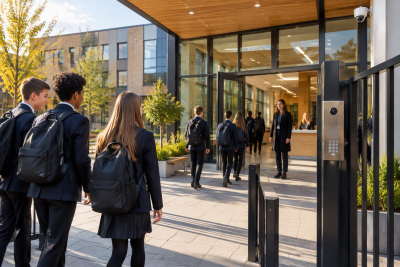
Educational establishments face growing pressure to provide safe, secure and resilient learning environments. An effective school security strategy brings together safeguarding, access control, CCTV, fire alarms, visitor management, lockdown, invacuation and emergency communication systems.
Whether you are responsible for a nursery, primary school, secondary school, multi-academy trust, college or university campus, an integrated approach can help protect students, staff and visitors while supporting compliance, operational resilience and effective emergency response.
Quick Answer
Modern school security systems combine technology, procedures and staff response to control access, manage visitors, support safeguarding and communicate clear instructions during an emergency.
The most effective solutions are not necessarily those with the newest or most expensive equipment. They are systems that work together, cover the entire site and remain simple for authorised staff to operate under pressure.
Why School Security Has Never Been More Important
Schools, colleges and universities face security and life-safety challenges that extend far beyond protecting buildings and equipment.
Today’s education providers must consider:
- Student safeguarding
- Visitor and contractor management
- Fire safety
- Emergency communications
- Lockdown and invacuation procedures
- Access control
- Perimeter security
- Asset protection
- Protective security and Martyn’s Law preparedness
- Physical and digital security
- Community use and out-of-hours activities
Educational estates also change over time. Buildings are extended, temporary classrooms are introduced, entrances are moved and community use increases. Security arrangements that were suitable several years ago may no longer reflect how the site operates today.
This is why standalone systems are increasingly being replaced or supplemented by integrated solutions that provide greater visibility, consistency and control.
School Safeguarding Through Integrated Security Systems
Effective safeguarding depends on more than policies and staff training. The physical environment must also support the school’s safeguarding procedures.
Appropriately designed security systems can help schools:
- Control who enters the site
- Verify and record visitors
- Prevent unauthorised access to pupil areas
- Manage parent and carer collection arrangements
- Protect vulnerable students
- Secure restricted or higher-risk areas
- Support investigations when incidents occur
- Communicate promptly during an emergency
- Provide useful audit trails
Technology alone cannot deliver effective safeguarding. The strongest approach brings people, procedures and technology together, ensuring security measures support the day-to-day operation of the school rather than creating unnecessary barriers.
Education Security Systems at a Glance
| Security Requirement | Typical Solution |
|---|---|
| Visitor Management | Video intercoms, visitor management and access control |
| Student Safeguarding | Access control, CCTV and controlled internal movement |
| Fire Safety | Fire detection, alarm and emergency communication systems |
| External Threats | Invacuation and site-wide communication systems |
| Internal Security Incidents | Lockdown, access control and zoned communication |
| Site Security | CCTV, intruder alarms and perimeter protection |
| Multi-Building Campuses | Integrated and centrally managed security platforms |
| Out-of-Hours Protection | Monitored alarms, CCTV monitoring and remote management |
| Trust-Wide Management | Standardised, scalable systems with central reporting |
Fire Alarm Systems for Schools
Fire alarm systems are among the most important life-safety systems within any educational environment.
Depending on the building, risk assessment and system design, school fire alarm systems may provide:
- Automatic and manual fire detection
- Clear evacuation signals
- Addressable identification of affected areas
- Voice alarm or evacuation messages where appropriate
- Connections to access control and other building systems
- Remote monitoring where required
- Event records and system status information
Schools can present particular fire-safety challenges because of:
- Large and varied student populations
- Multiple buildings and teaching blocks
- Changes to classroom layouts
- Sports facilities and swimming pools
- Assembly halls and performance spaces
- Laboratories, workshops and kitchens
- Shared community use
- Temporary or modular classrooms
In our experience, one of the biggest challenges is that the building can evolve faster than the fire alarm system.
We regularly encounter:
- Classroom reconfigurations
- New internal partitions
- Building extensions
- Temporary teaching accommodation
- Changes of use
- Increased occupancy
Each of these changes can affect whether the existing fire detection and alarm arrangements remain appropriate for the building’s current layout and use.
School Lockdown and Invacuation Systems
Lockdown and invacuation systems are becoming an increasingly important part of safeguarding, protective security and emergency preparedness.
Unlike a fire alarm, which normally instructs occupants to leave a building, lockdown and invacuation procedures may require people to take very different actions.
What Is an Invacuation?
An invacuation brings people into a building, or moves them to safer internal areas, when a threat or hazardous situation exists outside or close to the premises.
What Is a Lockdown?
A lockdown restricts movement and secures designated areas when allowing people to move freely around or leave the premises could increase the risk.
A properly designed lockdown and invacuation solution may provide:
- Clearly distinguishable audible alerts
- Visual notifications
- Staff messaging
- Whole-site communication
- Zoned alerts where required
- Multiple authorised activation points
- Integration with access control
- Automatic notification sequences
- Central event logging
The alert must be clearly understood and distinguishable from the fire alarm, lesson-change bell and other routine signals. Staff also need to understand what each signal means and what action they are expected to take.
Real-World Example: Improving School Lockdown Procedures Without Replacing Existing Infrastructure
A recent school project demonstrated why educational establishments should test how their emergency procedures work across the whole site, rather than relying on how those procedures appear on paper.
The project was driven by two objectives:
- Strengthening the school’s safeguarding arrangements
- Improving protective security and emergency preparedness
Like many schools, the site already had a lockdown and invacuation procedure. Staff had been trained to activate the existing school bell continuously for one minute.
The procedure appeared straightforward, but the underlying infrastructure created a significant weakness.
The Challenge
The school occupied several buildings across one campus. Its bell system was controlled by three separate timeclock controllers located in different buildings.
As a result:
- Activating the bell in one building only alerted that building
- Approximately two-thirds of the school could receive no immediate notification
- Staff depended heavily on manual communication
- Different parts of the campus could react differently to the same incident
- Incident response could be delayed
The site effectively had three separate alert arrangements rather than one coordinated, campus-wide emergency notification system.
The Solution
Rather than recommending the complete replacement of the existing infrastructure, we assessed how the school’s current systems could work together more effectively.
The school already operated a Paxton Net2 access control platform. By integrating Net2 with the existing bell infrastructure, we were able to improve emergency communication while retaining procedures and signals already familiar to staff and students.
Centralised Bell Management
Previously, lesson-change times were managed independently through three separate bell controllers. Following integration, schedules could be managed centrally, helping provide consistent operation across the campus.
Multiple Emergency Activation Points
Dedicated emergency control points were installed at selected locations. Authorised staff no longer needed to reach one particular reception area or bell controller to initiate an emergency alert.
One-Press Invacuation Activation
The original procedure required a member of staff to hold the bell control continuously for one minute.
The upgraded system introduced a single-button control that automatically completed the required notification sequence. This removed the need for someone to remain at the controller and helped ensure the same signal was produced consistently.
Coordinated Lockdown Control
The school’s existing access control infrastructure was also used to coordinate selected door functions as part of the agreed lockdown procedure.
Any automatic door response must be carefully designed around the school’s risk assessment, escape requirements and operational procedures. The intention is to support incident management without creating additional risks or preventing safe escape where required.
Retaining Familiar Alerts
An important advantage was that the established alert signal remained familiar to staff and students.
The school improved the reliability, reach and operation of its emergency notification without unnecessarily introducing a completely unfamiliar alert or replacing serviceable infrastructure.
The Outcome
The project delivered:
- Site-wide emergency notification
- Improved safeguarding arrangements
- More consistent incident response
- Multiple authorised activation points
- Automated notification sequences
- Centralised bell management
- Reduced dependence on manual communication
- Better use of infrastructure the school already owned
- A more cost-effective alternative to complete system replacement
What This School Lockdown Project Taught Us
Having a written lockdown procedure is not the same as having an effective lockdown system.
Arrangements often evolve alongside:
- Building extensions
- Temporary classrooms
- Additional teaching blocks
- New entrances
- Changes to internal layouts
- Different safeguarding expectations
The question schools should ask is not simply:
“Do we have a lockdown procedure?”
A more useful question is:
“Can every member of staff, student and visitor receive and understand the same instruction at the same time, wherever they are on site?”
For many schools, testing that question across every building, outdoor area and temporary classroom quickly identifies opportunities for improvement.
Access Control Systems for Schools
Managing who can enter, move around and leave a school is a fundamental part of safeguarding and site security.
Modern school access control systems can provide:
- Controlled staff access
- Restricted access to pupil and sensitive areas
- Time-based permissions
- Door and user audit trails
- Controlled parent and carer collection arrangements
- Management of community and out-of-hours users
- Integration with intercom and CCTV systems
- Central administration across several buildings
One of the most common issues we encounter is schools gradually outgrowing their original access control system.
A system installed initially for one reception entrance can become difficult to manage when:
- Additional buildings are added
- New entrances are introduced
- Community facilities are shared
- Out-of-hours activities increase
- Access permissions are not regularly reviewed
- Different systems are installed in different buildings
Planning for scalability, central management and future expansion is therefore as important as addressing the school’s immediate requirements.
Visitor Management Systems for Schools
Visitor management begins before someone reaches a pupil area. Schools need a clear process for identifying, authorising, recording and supervising visitors, contractors and other site users.
An integrated visitor management solution may support:
- Reception sign-in and sign-out
- Pre-registration of expected visitors
- Temporary visitor passes
- Contractor management
- Recording agreed safeguarding information
- Host notifications
- Late-arrival procedures
- Parent and carer collection arrangements
- Emergency roll-call information
- Integration with doors, intercoms and access control
The goal is not simply to create a digital visitor book. The system should help the school understand who is on site, why they are there, where they are permitted to go and who is responsible for them.
CCTV Systems for Schools and Education
CCTV can support:
- Student safeguarding
- Incident investigation
- Staff protection
- Perimeter monitoring
- Vandalism deterrence
- Asset protection
- Management of entrances and shared areas
Modern CCTV platforms may also provide:
- Centralised viewing across multiple buildings
- Remote access for authorised users
- Faster recorded-video searching
- Event-based alerts
- Occupancy and movement information
- Integration with access control and intercom systems
CCTV must be introduced for clearly defined purposes and operated with appropriate governance, access controls, retention arrangements and privacy considerations.
When designed and managed correctly, CCTV can support safeguarding and incident management without becoming a substitute for proper supervision, procedures or staff judgement.
Security Systems for Multi-Academy Trusts
Multi-academy trusts face the additional challenge of managing security across schools that may have different buildings, legacy systems, contractors and operating procedures.
A trust-wide security strategy can help MATs:
- Establish consistent safeguarding and security principles
- Standardise lockdown and invacuation terminology
- Compare risks and priorities across multiple schools
- Centralise selected system administration and reporting
- Reduce unnecessary differences between sites
- Plan lifecycle replacement more effectively
- Develop approved equipment and system standards
- Improve procurement and maintenance consistency
Standardisation does not mean every school must have an identical system. Each site has its own layout, risks and operational needs.
The objective is to create a consistent strategic framework while allowing individual schools to implement proportionate, site-specific solutions.
Security Solutions for Nurseries and Early Years Settings
Early years environments require particularly robust safeguarding and collection procedures.
Controlling who can:
- Enter the premises
- Access rooms used by children
- Move beyond reception
- Collect a child
is fundamental to the security of the setting.
Nursery and early years security solutions may include:
- Video intercom systems
- Electronic access control
- CCTV at entrances and appropriate shared areas
- Visitor management
- Secure gates and perimeter protection
- Controlled collection procedures
- Staff communication and emergency alerts
The principal objective is to ensure children are released only through authorised and clearly understood procedures.
Security Systems for Colleges and Universities
Further and higher education campuses can operate more like small towns than traditional schools.
Typical requirements can include:
- Enterprise access control
- Student accommodation security
- Campus-wide CCTV
- Multi-building fire alarm management
- Emergency communication platforms
- Laboratory and research-area access
- Public-event management
- Remote and centralised system administration
These settings can present additional challenges because of:
- Extended or 24-hour occupancy
- Public access
- Multiple stakeholders
- Research and specialist facilities
- Student accommodation
- Large and diverse estates
Scalability, system integration and clearly defined management responsibility are often central to a successful campus security strategy.
Sports Halls, Swimming Pools and Leisure Facilities
Sports halls, leisure centres, swimming pools and outdoor facilities present different operational and security challenges from classroom environments.
These may include:
- Wet or humid conditions
- Large open spaces
- Public and community access
- High-occupancy events
- Multiple entrances and changing areas
- Areas remote from the main school reception
- Evening and weekend use
Security and communication systems must remain reliable in the environment where they are installed and must account for how the facility is used throughout the day.
Martyn’s Law and Education Settings
Martyn’s Law is the commonly used name for the Terrorism (Protection of Premises) Act 2025. The legislation is intended to improve protective security and organisational preparedness at qualifying premises and events.
The Act has become law but is subject to an implementation period before its requirements come into force. Separate statutory guidance for education settings is expected during that period.
Education premises expecting 200 or more people to be present may fall within scope. Special tier arrangements apply to premises used for early years, primary, secondary and further education.
Importantly, Martyn’s Law is not simply an instruction to install more security equipment. The focus is on proportionate public-protection procedures and how an organisation would respond if an incident occurred.
For schools and other education providers, relevant considerations may include:
- Evacuation
- Invacuation
- Lockdown
- Emergency communication
- Staff awareness and training
- Testing and reviewing procedures
- How instructions reach people across the entire site
Schools should follow current government guidance and review their arrangements as further statutory guidance is published. Technology may support these procedures, but it should be selected only after the school has considered its risks, responsibilities and operational requirements.
Common School Security Challenges We Encounter
Many school security weaknesses are not caused by one major system failure. They develop gradually as buildings, staffing arrangements and site operations change.
Common issues include:
- Temporary classrooms that cannot receive emergency alerts
- Separate systems operating independently in different buildings
- Legacy access control that is difficult to administer
- Inconsistent lockdown signals or terminology
- Entrances introduced without a wider security review
- Shared community facilities with unclear access arrangements
- Out-of-hours users operating under different procedures
- Visitor processes that rely too heavily on manual action
- Access permissions that have not been reviewed
- CCTV systems that no longer reflect safeguarding priorities
- Fire alarm arrangements affected by changes to the building
- Several contractors managing connected systems independently
In many cases, the answer is not complete system replacement. A structured review may identify opportunities to improve integration, procedures, coverage and management while retaining serviceable equipment.
School Security and Lockdown Readiness Checklist
Schools and trusts should consider the following questions:
- Can every occupied building receive an emergency alert simultaneously?
- Can staff and students clearly distinguish the lockdown signal from the fire alarm and lesson-change bell?
- Can authorised staff activate an alert from more than one suitable location?
- Are temporary classrooms, sports facilities and outdoor areas included?
- Would visitors understand what to do during an incident?
- Have building extensions or layout changes affected system coverage?
- Are controlled doors included safely within emergency procedures?
- Are escape requirements considered within any automatic locking strategy?
- Are visitor, contractor and parent access arrangements clearly defined?
- Are access permissions reviewed when staff roles change?
- Have procedures been practised and reviewed?
- Is the system simple enough to operate under pressure?
- Does the current technology support the school’s safeguarding procedures?
- Can the school demonstrate how identified weaknesses are being managed?
If the answer is “no” or “we are not sure” to any of these questions, it may be appropriate to review the school’s current arrangements.
School Security and Safeguarding Review
School security systems often develop gradually as buildings, safeguarding requirements and student numbers change. This can leave gaps between individual systems and the procedures they are intended to support.
I Security Ltd provides practical school security and safeguarding reviews to help educational establishments understand existing arrangements and prioritise proportionate improvements.
A review can consider:
- Site access and perimeter arrangements
- Reception and visitor management
- Access control
- CCTV coverage and operation
- Fire alarm arrangements
- Lockdown and invacuation communication
- Temporary classrooms and additional buildings
- Emergency activation points
- System integration opportunities
- Maintenance and lifecycle planning
The purpose is not to recommend unnecessary replacement. It is to identify practical gaps, understand how existing systems support current procedures and develop a sensible improvement plan.
[INSERT-CONTACT-PAGE-URL]Book a School Security Review
Frequently Asked Questions
What is an invacuation system?
An invacuation system helps direct occupants into a building or towards safer internal areas when a threat or hazardous situation exists outside or near the premises. Unlike an evacuation, people do not simply leave the site.
What is the difference between lockdown and invacuation?
An invacuation generally brings people inside or moves them to safer internal locations in response to an external threat. A lockdown restricts movement and secures designated areas when moving around or leaving the premises could increase the risk.
Do schools need a dedicated lockdown system?
The appropriate solution depends on the school’s risks, buildings, procedures and existing infrastructure. A dedicated standalone system is not always necessary, but the school must ensure its arrangements can communicate clear and consistent instructions across the areas that may be occupied.
Can an existing school bell be used for lockdown alerts?
An existing bell may form part of the solution if the signal is clearly understood, distinguishable from other alarms and capable of reaching all relevant areas. The system should also be tested to confirm that every occupied building can receive the alert.
Can an existing school bell system be upgraded?
Yes. Depending on the equipment and site layout, it may be possible to centralise existing bell controllers, add authorised activation points or integrate the system with access control and emergency communication equipment.
Can access control lock doors automatically during a lockdown?
Some access control systems can coordinate selected doors as part of an agreed lockdown response. Any automatic action must be designed carefully around the site risk assessment, fire strategy, escape requirements and safeguarding procedures.
How often should school lockdown procedures be reviewed?
Procedures should be reviewed whenever there is a significant change to buildings, occupancy, staffing, access arrangements or identified risks. Schools should also include periodic testing and review within their wider emergency-planning arrangements.
How can schools manage visitor access safely?
Effective visitor management combines a controlled entrance, identity and purpose checks, clear authorisation, appropriate visitor identification, host responsibility and restrictions on access beyond reception.
Do multi-academy trusts benefit from integrated security systems?
Integrated systems can help trusts establish consistent security principles, centralise selected management functions and plan upgrades across several schools. Each site should still receive a proportionate assessment based on its buildings, users and risks.
Does Martyn’s Law require schools to buy new security equipment?
Martyn’s Law focuses on proportionate public-protection procedures and organisational preparedness. It does not automatically mean every school must purchase a particular system or make extensive physical alterations. Schools should assess their arrangements and follow the statutory guidance issued during implementation.
Expert Advice
One of the biggest mistakes schools make is assuming a lockdown procedure remains effective simply because it exists. As sites expand, buildings change and safeguarding expectations develop, emergency communication arrangements must be reviewed as well.
The most successful educational security projects are not necessarily those with the newest technology.
They are the projects that make existing systems work together effectively, address identified risks and remain straightforward for staff to use during a real incident.
Creating Safer Learning Environments
Modern educational security is about more than controlling doors or installing cameras.
It is about creating an environment where students can learn, staff can teach and visitors can be managed safely and effectively.
The strongest school security strategies bring together:
- Safeguarding procedures
- Access control
- Visitor management
- CCTV
- Fire alarms
- Lockdown systems
- Invacuation systems
- Emergency communications
- Staff training and testing
The most successful projects are rarely those with the largest budgets. They are the projects that identify the real risks, make sensible use of existing infrastructure and deliver the right solution for the people using the building every day.